Friday, August 10, 2012

Reserve Bank backflips with optimistic growth forecasts

By Business editor Peter Ryan


The Reserve Bank has backflipped on its earlier cautious forecasts for the Australian economy after a raft of stronger than expected data in recent weeks.

The central bank now sees economic growth at 3.75 per cent by the end of year after earlier predictions of just 3 per cent.

The revisions are outlined in the RBA's quarterly statement on monetary policy released today.

"Information released over the past two months suggests that the Australian economy grew more rapidly over the past year than had been previously indicated by the available data," the statement said.

"Available data suggest that household consumption also grew strongly over the first half of 2012. Retail sales growth picked up in the March and June quarters to around its strongest pace in two years."

However, the RBA says various government payments made to households in May and June in relation to the carbon price "had a noticeable effect on sales at some retailers."

In a bullish statement, the RBA also notes "tentative signs" that the housing market and resident building sector may be starting to improve.

"There are signs that that residential activity might start to pick up in the second half of 2012. Lower interest rates, rising rental yields and population growth are likely to provide support for new housing construction."

The RBA says employment growth has increased "a little faster" in the first half of the year, mainly in the booming resources sector.

However, it confirms that job shedding has continued in the manufacturing, hospitality and building construction industries.

The RBA expects the officially jobless rate to remain at around 5.25 per cent, in line with yesterday's official reading for July of 5.2 per cent.

The central bank's forecast for headline inflation is little changed at 1.2 per cent before moving higher to peak at 3.5 per cent in June 2013.

The RBA says the increase reflects earlier volatility in fruit and vegetable prices and the carbon tax passing through to consumer prices. Treasury has previously forecast the carbon price to add 0.7 per cent to headline inflation.

The RBA has also warned that a persistently high Australian dollar - which surpassed 106 US cents yesterday - had the potential to derail structural reforms to the economy.

It points to a risk that "improvement in productivity growth is not sustained as assumed" and could "put upward pressure on inflation.

The RBA says the debt crisis in Europe is the single biggest threat to the global economy, although it is more optimistic about a resolution.

"The forecasts assume that financial market volatility will remain high but that a severe economic and financial disruption to the euro area will be avoided."

However, it says "an adverse shock" would hit commodity prices and reduce Australia's terms of trade by more than is currently forecast.

The statement also confirms this week's decision by the RBA that the cash rate "remained appropriate" for now.

Market economists believe that means further rate cuts in 2012 are unlikely.


Thursday, August 9, 2012

No news today: Murdoch bans reporter questions at finance briefings

By Business editor Peter Ryan

It was once a highly anticipated quarterly event for journalists - the opportunity to put a rare question to Rupert Murdoch or one of his high flying executives.

But today, the man who lives and breathes the media, showed he doesn't necessarily appreciate having journalists questioning the direction of the News Corporation empire - especially in these troubled times.

Read the story on ABC News Online

In an advisory to journalists about this morning's teleconference on the empire's quarterly earnings, reporters reading the fine print discovered that while they were invited to dial in, it would be on "a listen only" basis.

In the past, reporters were allowed a "window" near the end of the call to queue for questions once the grilling from financial analysts were completed

So disappointed reporters from around the globe, including this one, were sidelined while analysts monopolised questioning of News Corporation president Chase Carey, chief financial officer David Devoe and deputy chief operating oifficer James Murdoch.

Rupert Murdoch was not on the call at today's briefing although he has regularly fronted many briefings in the past taking questions ranging from his love of newspapers, the British phone hacking scandal and who will succeed him once he goes to the big newsroom in the sky.

Hacks questioning the surprise move have been told by News Corporation corporate affairs that the company is moving in line with other US based companies that do not allow journalist question during results briefings.

The answer was non-committal when the ABC asked if News Corporation would consider holding separate media briefings in the future.

The decision by News Corporation to exclude reporters questions ensured this morning's teleconference relating to a US$1.6 billion quarterly loss, was a pedestrian affair.

Here's my analysis from this morning's edition of AM.

There were no inconvenient questions about the UK phone hacking scandal, the future of the global newspapers business or the reputational damage the empire had sustained.

But it wasn't always that way.

Rupert Murdoch has often used financial teleconferences to outline his wide ranging views on political and economic matters assisted by questions from the odd pesky journalist.

For example, in August 2010 during the federal election, Mr Murdoch dispensed with me efficiently when I asked him to say who he'd prefer as Prime Minister.

PETER RYAN: I just wanted to get your thoughts on the Australian election campaign. What are you seeing as the big issues for the economy? And who would you want to see as the prime minister of Australia - Julia Gillard or Tony Abbott?

RUPERT MURDOCH: I think I have no comment at all. Just read our newspapers and see what our editors think. They have the freedom to decide that. We're obviously watching it closely. And there haven't been any really great issues emerge yet.

PETER RYAN: What's your view of the campaign and how it's been conducted by the two leaders? It's been criticised by some quarters back here as being a bit of a debacle.

RUPERT MURDOCH: Well that might be true of the ABC's comments but, and what part you're playing in it. So I think I'll just let that pass.
(Laughter)


A year later on, I asked Mr Murdoch how his succession plans were going given the pressure James Murdoch was facing in relation to the News of the World scandal.

Mr Murdoch made news by nominating Chase Carey, rather than one of his own children as his successor:
 
RUPERT MURDOCH: Well I hope that the job won't be open in the near future (laughter) and I ahh, I have, I have you know Chase is my partner if anything happened to me I'm sure he'll get it immediately but if I went under a bus but Chase and I have full confidence in James but you know in the end the succession is a matter for the board.  

There are many more moments like these that unlikely to be repeated in a briefing dominated by questions from financial analysts.

And before you suggest this reporter's nose is out of joint, there is the public interest to consider.

The role of a journalist is to shine a light into dark corners, and by blocking journalists questions, one can only assume there are questions News Corporation and Rupert Murdoch would prefer not to confront.


Tuesday, August 7, 2012

Standard Chartered branded a "rogue institution" after alleged illegal dealings with Iran


One of the world's biggest banks is being pursued by US regulators over claims that it violated anti-terror laws by dealing with Iran.

The London-based Standard Chartered Bank has been branded as a "rogue institution" after allegedly hiding transactions valued at US$250 billion.

The bank has rejected the claim, but the scandal could see Standard Chartered stripped of its licence for the state of New York which could ultimately cut if off from lucrative US financial markets.


According to New York's Department of Financial Services, Standard Chartered is a "rogue institution" that broke US law and exposed America's banking system to terrorists, drug traffickers and corrupt states.

The department claims the bank "schemed" with the Iranian government to conduct 60,000 secret transactions that generated hundreds of millions of dollars in fees.

The dealings go back as far as 2006 when, it alleged, Standard Chartered insider debated whether to continue the Iranian dealings.

A top US-based employee warned head office in London that the dealings could cause "catastrophic reputational damage" and "serious criminal liability".

A top executive in London shot back: "You f---ing Americans. Who are you to tell us, the rest of the world, that we're not going to deal with Iranians."

Regulators say that reply shows an obvious contempt for US banking regulations and already there are moves to strip Standard Chartered of its New York licence which allows it to process US$190 billion every day.

The loss of a New York banking license would be a devastating blow as it would cut off direct access to the lucrative US financial services sector.

Meanwhile Standard Chartered issued a statement rejecting the claims and says it ceased all new business in any currency with Iranian customers over five years ago.

"The Group takes its responsibilities very seriously, and seeks to comply at all times with the relevant laws and regulations. It is in this spirit we initiated this review and have engaged with the US agencies."

Investigations are focussing on so-called "u-turn" transactions where Standard Chartered allegedly moved money for Iranian clients among banks in Britain and Middle East and cleared through Standard Chartered's New York branch, but which neither started nor ended in Iran.

Such transactions have been illegal since November 2008, when the Treasury Department banned them on concerns that they were being used to evade sanctions, and that Iran was using banks to fund nuclear and missile development programs.

Standard Chartered shares dived six percent in late London trade and fell as much in seven percent when they opened in Hong Kong this morning.
 

Friday, July 13, 2012

Laker's missing commandment: Thou shalt not be stupid

The corporate watchdog has flagged a crackdown on complex financial products that could breach the spirit of the law.

The Australian Securities and Investments Commission (ASIC) is chairing a global push to crack down on risky products which can potentially be used to get around takeover regulations.

Listen to my analysis broadcast this morning on AM.

ASIC is concerned about derivative products, such as contracts for difference, which are retailed widely in Australia.

A common form of these products allows investors to bet on a share price to fall, even without putting down money upfront.

As part of the bigger picture, such derivatives can help facilitate major deals that could involve billions of dollars in proposals which can be made without proper financing.

Now ASIC chairman Greg Medcraft says he is very worried about derivatives.

He is chairing a global taskforce with the French regulator in a bid to get ahead of certain banks which are skirting regulations.

"They are basically manufactured on a global basis by banks, etc, so perhaps there should be some guidance or standards established for the way that the products are actually basically regulated," Mr Medcraft observed.

"You know, one of the things you are trying to do is make sure you have consistent global rules. So, you know, that's what we're looking at."

This scrutiny on derivatives comes as ASIC also takes a very close look at current takeover laws - whether they are outdated, provide proper disclosure or demonstrate that innovation is now outstripping the spirit of the law.

Earlier this week, AM broke the story that ASIC wants to overhaul so-called creep laws, where a corporate raider can use a loophole to gradually up their stake in a company without paying a premium.

That was a thinly veiled swipe at Gina Rinehart and James Packer in relation to Fairfax Media and Echo Entertainment respectively.

However, when it comes to preventing crippling losses, the corporate and banking regulators say there is only so much they can do and they certainly do not have any laws to outlaw bad decisions or, indeed, stupidity.

Both ASIC and the banking and insurance regulator APRA (the Australian Prudential Regulation Authority) say many of the poor decisions that have sent companies bust or hurt investors badly come down to decisions made on company boards.

ASIC's Greg Medcraft made the point that directors should at least be able to understand a balance sheet to fulfil their duties in monitoring the business.

APRA's chairman John Laker told a conference hosted by The Economist magazine in Sydney yesterday that boards need to take more responsibility, but he cannot do much about highly paid stupid people.

"I've been in a lot of discussions about the role of regulation where the word board doesn't get mentioned and it should," he said.

"That is the starting point for this financial system, not the regulator. So we can't regulate against reckless behaviour. 

"We can certainly do our best to intrude, to identify and to modify it, but show me a piece of paper that says thou shalt not be stupid. I'd love the regulation but, you know, that won't help me at all."

Wednesday, July 11, 2012

ASIC pursuit of David Jones mystery bidder "continuing".

By Business editor Peter Ryan

The corporate watchdog says it's still investigating the recent bizarre takeover bid for the David Jones department store.

The surprise offer from an unknown private equity company in Britain saw the David Jones share price rocket almost twenty percent only to plunge when the bid was withdrawn.

The chairman of the Australian Securities & Investments Commission Greg Medcraft told AM that discussions are under way with regulators in other countries to determine the identity and
whereabouts of EB Private Equity and its alleged founder John Edgar.

"We're liaising with UK authorities and continuing our investigation," Mr Medcraft said.

"When we have situations like this there are a number of courses of action we take. First of all, it's working with our fellow regulators in other jurisdictions and also looking at price activity is clearly something we look at."

Mr Medcraft said ASIC was working to update rules on continuous disclosure after the release of the $1.6 billion mystery offer caused market mayhem and sparked concerns the DJs share price was being manipulated.

"We will work with ASX to look to update disclosure laws. It has been clear for some time that the guidance needs to be updated particularly with the impact of social media and making sure social media doesn't send the wrong price signals to the market," Mr Medcraft said.

A review of disclosure rules could centre on whether to call a trading halt if a company is not satisfied that price signals to the market were not accurate.

The regulator has confirmed it's scrutinising share trades on the day to determine who stood to make a windfall from the unsubstantiated bid which could still turn out to be a hoax.

So does ASIC think the DJ's bid was a hoax? Mr Medcraft was coy in his reply.

"All I say we are continuing to investigate. I can't really say any more than that."

However, Mr Medcraft admitted the bid came as a shock to the market, while pledging to refine rules for chaning times.

"I think the market was surprised. We saw what happened. You're shaped by experience and now we have to make sure we are shaped by experience and we need to learn from that to ensure it doesn't happen again," Mr Medcraft said.

ASIC is also confronting the widening use of social media and its use as a tool in sending viral messages that could contain price signals.


"Social media is now a fact of life and that in itself will shape change."

Corporate cop seeks to overhaul "creep" rules to stop "takeovers by stealth"

By Business editor Peter Ryan

The current corporate manoeuvres by Gina Rinehart and James Packer have attracted the attention of the corporate watchdog.


The Australian Securities & Investments Commission is moving to tighten or close legal loopholes used by the multi billionaires to increase their stakes in Fairfax Media and Echo Entertainment.

Listen to my interview with the ASIC boss broadcast this morning on AM.

The regulator is seeking to overhaul so-called "creep" provisions where corporate raiders can ramp up their shareholdings by three percentage points every six months once they surpass 19.9 percent without paying a premium for a formal takeover bid.

ASIC's chairman Greg Medcraft told AM that the legal but destablising use of "creep" tactics by corporate raiders needed to be overhauled.

"I think that the current creep provisions are an anachronism. It is basically allowing takeover by stealth which I think is inconsistent with the takeover law in terms of making sure that when there is a change of control and there is a premium to be paid that all parties can share in that," Mr Medcraft said.

Responding to a question on whether Mrs Rinehart or Mr Packer needed to make formal takover offers rather than using "creep" loopholes, Mr Medcraft said:

"I think there is probably a need to clarify the issue of takeover law. Perhaps we need to think about the UK provision which is put up or shut up. Basically, if you are going to make a takeover offer, it has actually got to be very clear and very committed."

Mr Medcraft did not name Mrs Rinehart or Mr Packer directly.

However, he made it clear that the regulator is concerned about recent boardroom battles where the respective chairmen at Fairfax Media and Echo Entertainment have been subjected to high profile personal attacks.

"Where there are means other than legal or other means used to take control of a board, then I believe that needs to be looked at in terms of the spirit of the takeover laws," Mr Medcraft said.

"We are all about making sure that markets are fair and efficient and particularly that they are fair, orderly and transparent. If any of those principles are compromised then clearly we (ASIC) have an interest."


ASIC has written to Treasury requesting that "creep" provisions need to be reviewed by the government, with the view of reducing gradual ownership to one percentage point per six months rather than the current three percentage points.

ASIC is also advocating a possible adoption of British takeover rules where the "put up or shut up" rule is enforced.

"The situation in the UK is that if you make an offer it has to be clear and it has to be committed. It can't be ambiguous or highly conditional so it has actually got to be a clear and committed takeover and if its not and if you don't deliver on it, then there are consequences."

ASIC has become increasingly concerned about takeover bids after the bizarre takeover bid for David Jones which caused wild sharemarket swings.

Twitter: @peter_f_ryan
 

Monday, July 9, 2012

Hastie early exit advice ignored, says report. Claim that Deloitte urged board to consider employee dismissal issues a year ago.


By Business editor Peter Ryan
                    

A draft report into the collapse of the Hastie Group's Middle East operations says a proposal made last year for a "managed wind-down" was ignored.

Listen to the report from this morning's edition of AM.

According to the report, the accounting firm Deloitte recommended a "controlled closure" and warned that employee dismissal issues needed to be considered.

The review - conducted by remaining Hastie managers on the ground - slams the Hastie board for mishandling the company's exit which has left a thousand local labouring staff without entitlements.

The executive summary obtained by AM reveals that Hastie appointed Deloitte to provide proposals on reducing its exposure in the Middle East, well before the group's 44 companies collapsed in May.

Deloitte told the Hastie board on August 17 last year that there was an opportunity to exit the Middle East and to ensure employee matters were handled appropriately.

The report says the Deloitte recommendation "clearly highlighted that a managed wind-down required a controlled closure of the Middle East businesses and that there were employee issues to be considered."

"This advice was disregarded by the Hastie Board, their banking syndicate and authorised senior management in the UAE and Hastie have subsequently completely mismanaged their exit from the Middle East."


Charles Lever, a former Hastie executive manager who authored the report, says Hastie bungled an opportunity for a clean exit that protected staff and creditors.

"They took it upon their own remit to close the business down without having taken into account what Deloittes had obviously advised them and what we and other people from the Middle East management had advised them was necessary," Mr Lever told AM.

"The people providing the food to the labour camps refused to provide food. The labourers didn't get paid from May, and that of course causes them problem in terms of getting funds back to their families, whether it be in Bangladesh, the Philippines, India or even if it's western expats getting back to their family."

The ultimate collapse of Hastie in the UAE left around a thousand labourers out of work, and while some have been redeployed, none have received their termination entitlements as required under law. The collapse initially claimed 2,700 jobs in Australia although many workers have now been redeployed.

Local managers in the UAE were left to deal with distressed employees after A$3 million was drained from Hastie's Dubai bank account days before administrators were appointed on May 28.


Post-dated cheques, written before the collapse, are starting to bounce opening the prospect of arrest and imprisonment for staff.

Already, one former senior manager, Gavin Appleby, has fled to Norway to avoid arrest after he had signed a number of cheques.
   .
The report also slams a decision by the administrator PPB Advisory to allow a senior Hastie executive, Gary Allen, to flee the UAE with the equivalant of A$100,000 which was an emergency fund meant to cover staff payments.


Joint administrator and PPB partner Craig Crosbie has defended the decision to allow the emergency funds to be taken.

"PPB Advisory was happy to make available company funds to Hastie International management who required the funds for expenses on the condition it was properly accounted for," Mr Crosbie said in a written statement.

"We left it up to the general manager to make a judgment as to how the funds would be used."

PPB says it had no involvement in Hastie affairs prior to its appointment and could not comment on claims that advice from Deloitte had been ignored.

PPB has previously said it is working to manage "a complex situation" but is constrained because the Middle East is not covered by Australian law.

Twitter: @peter_f_ryan

Thursday, July 5, 2012

Bouncing cheques force Hastie retreat from UAE amid arrest fears

By Business editor Peter Ryan

A former senior executive of the Hastie Group has fled the United Arab Emirates fearing he was about to be arrested for bouncing cheques.


As AM reported last week, a number of post-dated cheques were issued by Hastie in the months and weeks before the company collapsed in May.

It's been confirmed that at one cheque has been dishonoured which opens the likelihood of serious prison time for Hastie's former regional chief executive Gavin Appleby.

Mr Appleby, whose signature appears on the cheques, has fled the UAE with his wife and family to the safety of Norway fearing a maximum of three years prison for each bad cheque.

The cheques - written before Mr Appleby resigned from Hastie in January - were to cover salaries, food and accommodation for around a thousand foreign labourers employer by Hastie in Dubai and Abu Dhabi.

Four remaining Hastie managers have used their own funds to cover the labourers' costs as they negotiate new work and full termination entitlements as required under UAE law.

One manager, Darren Hunt, is urging the company's Australian-based administrators to help telling AM last they needed to "get their arses over here".

Mr Hunt says the administrators, PPB Advisory, have rejected offers of assistance to sell assets and to recover outstanding debts.

However, administrators say it is not possible to help UAE staff who are not covered for entitlements under the safety net that exists in Australia.

Craig Crosbie of PPB Advisory told AM last week that Hasrie UAE staff were yet to provide necessary information on assets that could be liquidated.

Hastie's UAE bank accounts are empty and unable to cover cheques after A$3 million was transfered from Dubai to Sydney just days before the company was placed in administration.

Twitter: @peter_f_ryan

Tuesday, July 3, 2012

Barclays boss Bob Diamond resigns over LIBOR fixing scandal

Here's the statement released a short time ago by Barclays:

Board changes

Barclays today announces the resignation of Bob Diamond as Chief Executive and a Director of Barclays with immediate effect. Marcus Agius will become full-time Chairman and will lead the search for a new Chief Executive. Marcus will chair the Barclays Executive Committee pending the appointment of a new Chief Executive and he will be supported in discharging these responsibilities by Sir Michael Rake, Deputy Chairman.

The search for a new Chief Executive will commence immediately and will consider both internal and external candidates. The businesses will continue to be managed by the existing leadership teams.

Bob Diamond said "I joined Barclays 16 years ago because I saw an opportunity to build a world class investment banking business. Since then, I have had the privilege of working with some of the most talented, client-focused and diligent people that I have ever come across. We built world class businesses together and added our own distinctive chapter to the long and proud history of Barclays. My motivation has always been to do what I believed to be in the best interests of Barclays. No decision over that period was as hard as the one that I make now to stand down as Chief Executive. The external pressure placed on Barclays has reached a level that risks damaging the franchise - I cannot let that happen.

I am deeply disappointed that the impression created by the events announced last week about what Barclays and its people stand for could not be further from the truth. I know that each and every one of the people at Barclays works hard every day to serve our customers and clients. That is how we support economic growth and the communities in which we live and work. I look forward to fulfilling my obligation to contribute to the Treasury Committee's enquiries related to the settlements that Barclays announced last week without my leadership in question.

I leave behind an extraordinarily talented management team that I know is well placed to help the business emerge from this difficult period as one of the leaders in the global banking industry."

Commenting, Marcus Agius said, "Bob Diamond has made an enormous contribution to Barclays over the last 16 years of distinguished service to the Group, building Barclays Investment Bank into one of the leading global investment banks in the world. As Chief Executive he has led the bank superbly. I look forward to working closely with the Chief Executives of our businesses and the other members of the executive Committee in leading Barclays world class businesses in serving our customers and clients and delivering value for our shareholders."

Friday, June 29, 2012

Hastie Group labourers still high and dry in United Arab Emirates. Yet to receive a cent in payouts.


By Business editor Peter Ryan - EXCLUSIVE

Five weeks after the collapse of the Hastie Group, 1,000 staff based in the United Arab Emirates (UAE) have been left in the lurch, with their former managers forced to support them out of their own pockets.
Listen to the story broadcast on this morning's edition of AM.

In Australia, about 80 per cent of the 2,700 workers made redundant are now back working for other contractors, having received their full termination entitlements.

But the 1,000 mainly Indian and Bangladeshi labourers are yet to see a cent of their entitlements, known locally as gratuities, after Hastie's bank account was drained of $3 million just days before administrators were appointed.

And a small group of Hastie managers, who have been using their own money to help abandoned employees, claim they have been left high and dry by the administrators.

Hastie's general manager in Abu Dhabi, Darren Hunt, is one of four bosses left in the country, and like his workers, he feels abandoned.

He says managers have been left in the lurch and are standing by foreign labourers at their own personal expense to meet food and housing costs.

"I think that what has happened is criminal," he told AM.

"The three senior managers have absconded the country, left 940 employees in the Middle East.

"There is a humanitarian issue where we have got to accommodate people, we've got to provide food.

"We've got no funds to do that, we've got no access to do that and we've got no signatures to do that. I think there is a humanitarian issue and I think these people have got no morals doing what they've done."

"We are incurring, you know, daily expenses to try and make sure we do the right thing by these people.

"My personal expenses to date to Hastie are 90,000 dirhams which is probably 15,000 pounds, $30,000, I've got no chance of recovering."

Mr Hunt claims Hastie's Australian-based administrators have ignored offers to help sell assets and call in debts to open up the money pipeline to help pay out local employees.

"I've had interested parties in buying Hastie International Abu Dhabi, which was a profitable business, which had limited liabilities, and had quite a large debt in the market that was due and could have been collected," he said.

"That debt alone would have paid for all this to be administered properly and the business closed down properly."

The Hastie Group's joint administrator Craig Crosbie sympathises, but rejects those claims.

"We've actually asked that the management over there to articulate exactly what assets they are talking about but you know, none of that has been forthcoming unfortunately," he said.

And Mr Crosbie says he does not have the power to treat Hastie's foreign workers the same as Australians.

"In Australia in the circumstance we've got, we can make an application to the Federal Government and they step in and pick up these entitlements, which if we didn't have there would be a number of Australians who would be in the same boat as what these people in the Middle East are," he said.

But Darren Hunt will not be trying to sell that explanation to his workers.

"Get your arse to the UAE and help us with this situation, you know. It is unacceptable," he said.

Thursday, June 28, 2012

Fairfax Media shares flat as investors weigh Gina Rinehart threat to dump shares if board bid rejected

Fairfax chairman Roger Corbett closes boardroom door on Gina Rinehart

Statement from Fairfax Media chairman Roger Corbett 27 June 2012


Gina Rinehart's showdown with the Fairfax Media board has the potential to further damage the company as it rolls out a painful editorial restructure at the Sydney Morning Herald and The Age.

By closing the boardroom door on Gina Rinehart -  for now at least - Fairfax chairman Roger Corbett is sending the message that the definition of editorial independence has to be a collective view rather than that one tailored to the interests of individual powerful directors or investors.

Listen to my analysis broadcast on this morning's edition of AM.

I understand the Fairfax board remains concerned that Mrs Rinehart made no acknowlegement of the existing charter and certaintly doesn't accept the charter is binding on the Board.

Other big instituational investors are also known to have expressed concerns that a single board member blessed with special powers would set a dangerous precedent.

But some observers believe the issue of independence is just one part of Fairfax Media and Mrs Rinehart exclusion on the basis of the charter ignores other experience she could bring to the Board.

The media analyst Roger Colman of CCZ Equities says the current damaging game of boardroom poker needs to be decided by shareholders at the next annual general meeting.

"The board is backing the wrong horse in respect to that charter of editorial independence at metro markets," Mr Colman said.

"I think Gina should put it to the test at the next AGM and just see if she has the backing. She'll find out what the shortfall is and if she's got to buy more stock progressively over the next year and a half to two years, she should go for it.

"It's no different to Tony Abbott asking for an election against Julia Gillard. I mean, go to the people.

"This dispute has got to be settled in a single numerate count of shareholders votes."

Mrs Rinehart has not withdrawn her threat to dump all or part of her 18.67 percent stake in Fairfax if her demands for three board seats and editorial sway are not met.

There are concerns that any backlash could further undermine the Fairfax share price which hit a record low of 53.5 cents a share earlier this week.

But other big institutional investors might also be buyers.

They could well be concerned that their investments could be harmed if any erosion of editorial independence gets in the way of the survival strategy currently under way at The Age and Sydney Morning Herald.


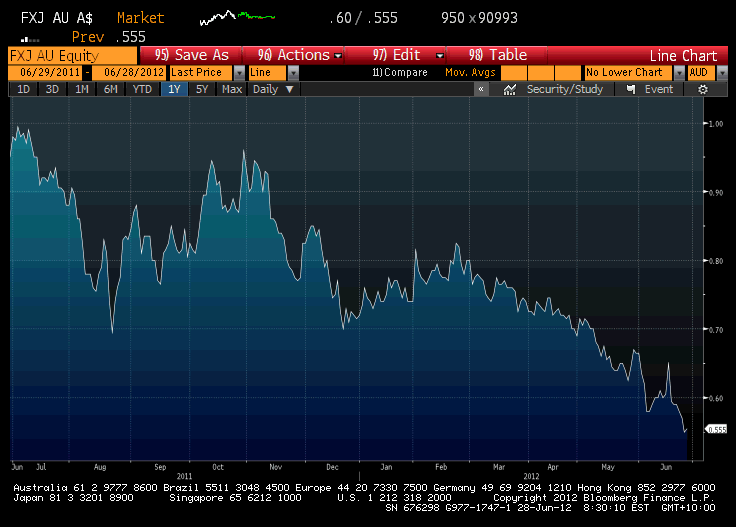
Falling fortunes: Fairfax share price year to 28 June 2012. Source: Bloomberg

Wednesday, June 27, 2012

Fairfax Media boss Greg Hywood defends Board's right to hire and fire. Confirms Rinehart discussions but says appointment a matter for Fairfax board.

By Business editor Peter Ryan

The chief executive of Fairfax Media says board members are entitled to debate the editorial direction of the company and make collective decisions about the appointment of editors.

However, Greg Hywood told AM this morning that individual directors or major shareholders did not have a right to tell journalists or editors what they should write.

Listen to the extended interview here.

Mr Hywood's comments on boardroom decisions and editorial independence come as Fairfax Media staff learn the details of the company's restructure which will see 1900 jobs axed, printing presses closed and The Age and Sydney Morning Herald converted to tabloid formats.

The Fairfax boss also confirmed he had "a terrific meeting" with the mining magnate Gina Rinehart who, as the single biggest shareholder, is so far refusing to honour Fairfax's charter of editorial independence.

"I mean she asked very pertinent questions about the company. We gave her a briefing about the company. It was an admirable meeting. It was a good meeting," Mr Hywood said.

However, Mr Hywood said he had no discussion with Mrs Rinehart about her bid for seats on the Fairfax board or a say in the company's editorial direction.

" We didn't discuss any of those issues. I mean, whether or not Mrs Rinehart comes onto the board or not is a board issue and, you know, we'll leave it at that," Mr Hywood said.

But the embattled publishing boss has this message for staff or Australians concerned about Fairfax's future under any new ownership.

"There's been a lot of speculation around editorial independence in relation to Fairfax. That will always stay. That is the core of this company."

At the same time, Mr Hywood defended Mrs Rinehart's right to be a vocal investor in Fairfax Media.

"Oh look, I think she's interested in journalism. She's interested in, you know, the future of Australia. She has her own opinions about that and she's entirely entitled to them. So I don't think there's anything controversial in that at all."


But Mr Hywood clarified the role of boardroom deliberations at Fairfax Media and the hypothetical scenario of how Mrs Rinehart's opinions would be managed if she secured one or more board seats.

"Look she's our major shareholder. As I said, whether or not she joins the board is up to the board. And if you're a board member editorial discussions are always held within board meetings," Mr Hywood said.

"What doesn't happen is it doesn't translate into board members telling journalists what they should or shouldn't write and that's our practice.

"The board is pre-eminent. The board operates collectively. No individual director can determine what the board does or doesn't do.

"And certainly, if someone buys the entire company and has more than 51 per cent of the company that's a different issue."

Mr Hywood refused to speculate on the scenario of Mrs Rinehart joining the board or the outlook for his role as chief executive if the mining magnate makes a full takeover bid.

"That's entirely speculative and hypothetical," Mr Hywood told AM.

Fairfax Media shares were 2.2 percent higher in late morning trade after hitting an intraday low of 53.5 cents yesterday.

Tuesday, June 26, 2012

Gina Rinehart threatens to dump Fairfax Media stake if boardroom demands not met. Shares at record low of 53 cents on ultimatum.


The mining magnate Gina Rinehart has threatened to dump her majority stake in Fairfax Media unless her demands for three boardroom seats and editorial sway are not met.
The ultimatum raises the stakes in Mrs Rinehart’s standoff with the Fairfax Media board which remains adamant it will not be bullied into capitulating for the demands.
In another dramatic days for the Australian media industry, Mrs Rinehart also increased her stake in the Ten Network further confirming her widening role as a media player.
Meanwhile, Andrew Holden was named as Editor in Chief at The Age after yesterday’s dramatic departure of three top editors.
Listen to my updated analysis broadcast on The World Today which covers the development that David Leckie had stepped down as chief executive of Seven West Media.

Monday, June 25, 2012

Fairfax Media loses three editors in one day as digital survival struggle gets real

Analysis: Desperately seeking a survival strategy at Fairfax Media

By Business editor Peter Ryan


There's an element of desperation in today's announcement from Fairfax Media that three top editors have decided to quit on the same day.

The imperative for Fairfax to act - and to act quickly - underscores how critical the coming days and weeks will be to the ultimate survival of Fairfax's two once-great metropolitan mastheads, The Age and The Sydney Morning Herald.

Working journalists usually come and go, and it's certain many will be leaving Fairfax more frequently than usual.

But the departures of Peter Fray and Amanda Wilson from the SMH and Paul Ramadge from The Age mark a dramatic turning point for the traditional and closely guarded power positions of editors and editors-in-chief.

Until today, those two fiefdoms carried often unquestioned editorial powers and distinct editors and editors-in-chief highlighted the rivalries and critical points of difference between The Age and the SMH, and the well-worn debate about pre-eminence between Australia's two biggest cities.

This afternoon's appointment of Sean Aylmer as editor-in-chief and Darren Goodsir as director of news at the SMH signal revamped editorial roles that dilute the powers of traditional Fairfax editors with decisions about national and international coverage ceded to a centralised hub.

While Fray, Wilson and Ramadage are leaving with dignity and no criticisms of the restructure which has claimed their careers, it is highly likely the weakened powers and the prospect of slashed budgets, major sackings and depleted journalistic firepower made a healthy redundancy package slightly more palatable.

Tomorrow's editorial revamp to be announced for The Age will be closely watched for confirmation on whether the editor-in-chief role remains or whether it is to come under a nationalised umbrella in Sydney.

A well-connected Fairfax observer says the latest dramatic developments show the editorial changes are, at the very least, "disruptive" but a necessary survival strategy for staff, investors, readers and advertisers.

The observer, close to Fairfax institutional shareholders, declined to be named but told the ABC the speed of the restructure confirms the stakes are high with Fairfax shares hitting a new low of 55.5 cents a share during the day. I was told,
Greg Hywood [Fairfax chief executive] and Roger Corbett [Fairfax chairman] really do have their backs to the wall.u can sense the desperation. Why else would you be unfolding this so quickly? They know that the company might not survive unless they engage in radical restructuring.
The biggest risk in this strategy is that they might actually accelerate the decline of print media. It's dramatic - switching from broadsheet to tabloid, taking some grunt out of your journalism, making advertisers less certain. This could exacerbate the decline.
In the end, this is mainly a downsizing exercise and managing the transformation of a big company into a small company.
However, today's announcement helps Fairfax deal with another threatening deadline in the shape of Gina Rinehart and her bid for three Fairfax boardroom seats along with a say in the hiring and firing of editors.

The initial appointments of an editor-in-chief and a director of news confirm that Fairfax is serious about major change, locking-in key editorial positions before Mrs Rinehart ups her 18.67 percent stake in the company.

But will this be enough for Fairfax's best loved mastheads to survive?

The key, according to one Fairfax watcher, is for the company to stop talking about the future and the beginning of a "new era" and to accept that the new digital world probably started at least 10 years ago.

Peter Ryan is the ABC's Business Editor, contributing to a range of ABC News programs including the flagship radio current affairs program AM. He tweets as @peter_f_ryan

Sydney Morning Herald & The Age editors to leave as Fairfax Media accelarates survival strategy

Thursday, June 21, 2012

Fairfax sackings on hold - for now - after industrial umpire steps in. Moral and legal obligation to consult ignored, unions complain.


Listen to my coverage of the ACTU's submission to Fair Work Australia broadcast on The World Today.

Stephen Conroy says Fairfax Media and News Ltd restructures highlight "beginning of the end" for print newspapers. Says weekday hard copies dead in five years.


By Business editor Peter Ryan


The dramatic restructures at both Fairfax Media and News Limited in recent days have put traditional printed newspapers on not much more than life support.

But this morning, the Communications Minister Senator Stephen Conroy said the accelerating events marked the beginning of the end for hard copy editions.


"The print newspaper is under enormous pressure and what you're seeing here is possibily the beginning of the end for the print newspaper," Senator Conroy said.

Speaking on Channel Nine, Senator Conroy described the rapid demise highlighted by Fairfax Media and News Limited restructures as "a very sad day".

Listen to my analysis and Senator Conroy's comments broadcast on this morning's edition of AM.

Read the ABC's rolling blog on the restructures at Fairfax and News Limited.

He called newspapers "venerable" institutions that "played a vital role in democracy."

But Senator Conroy signalled he was on a death watch with this prediction for traditional weekday editions.

"I wouldn't be putting money betting that there'll be print newspapers during the week in five years time. There's a very tough time in the print media sector at the moment."

Senator Conroy was speaking after New Limited revealed its digital future yesterday which includes plans to shrink 19 divisions to just five without putting a number on job cuts.

The move follows Fairfax Media, which announced on Monday that 1900 positions would be axed, the Sydney Morning Herald and The Age would go tabloid and printing presses in Sydney and Melbourne would be closed.

Senator Conroy has also expressed his concern at Gina Rinehart's bid for three Fairfax board seats and the opportunity to influence the editorial direction of key mastheads.

"I think the readership of Fairfax, the Sydney Morning Herald and The Age, would be in crisis if any owner was using a paper to promote their own overall commercial interests. This would be a disaster," Senator Conroy said.

"I would urge Ms Rinehart to sign the the charter of independence, accept that the Fairfax newspapers are not there to be a cheer squad for your own commercial interests."

In another development, the Australian Competition & Consumer Commission, said it would be reviewing News Limited's $1.97 billion proposed to buy James Packer's 25 percent stake in the pay television company Foxtel.

The deal, if approved, would give News Limited a 50 percent share of Foxtel with the other hald controlled by Telstra.
 
Twitter: @ peter_f_ryan

Wednesday, June 20, 2012

News Limited restructure a massive cultural change for staff and editors; 19 divisions shrink to five; but Kim Williams says print won't be abandoned

Stop Press? Fairfax Media's third biggest investor warns The Age & Sydney Morning Herald could close if restructure fails.


By Business editor Peter Ryan

Gina Rinehart's pursuit of editorial influence at Fairfax Media along with three boardroom seats seats is just one of the war fronts the embattled publisher is facing at the moment.

Now the third biggest holder of Fairfax stock is warning that the Sydney Morning Herald and The Age in Melbourne could be closed if the restructure announced on Monday fails to turn the company around.
The funds management group Allan Gray, which holds a nine percent stake, says Fairfax might be forced to sacrifice its metropolitan mastheads to focus on the more profitable rural publishing and digital businesses.

Allan Gray's managing director, Dr Simon Marais, told AM that The Age and The Sydney Morning Herald were in real jeopardy as Fairfax faces hard truths.

"I think the reason you buy Fairfax is not for the metro papers. They've got lots of other assets. And I think the other assets are probably worth more than the current share price," Mr Marais told AM.

"What the market's effectively saying is the metro papers are already worth less than nothing. They're a liability. But if that continues you'll probably just shut them down at some point. I think that's a real possibility."

Dr Marais identified standalone businesses outside of Fairfax's traditional publishing as worth saving such as Trade Me, Domain.com and Stayz.com.

Dr Marais made no apologies for taking a brutal approach to Fairfax's future given Monday's restructure which will axe 1900 jobs, close printing presses and convert The Age and SMH to tabloid formats.

And he signalled concerns about media diversity in Australia were an important but side issue for investors.

" I think over time if you don't have a good product you won't be able to sell it. But I think at some point it's unfair to expect a small portion of investors, mainly super funds, to pay for media diversity," Dr Marais said.

"I think the reality to people must be if you stop buying papers you won't have those papers."

Dr Marais said he was "neutral" about Gina Rinehart's bid for three boardroom seats and the right to intervene on editorial matters.

" You never have a right to a boardroom seat. But I think all other things being equal, it's better to have somebody with a lot of shares being a director than somebody that has no shares," Dr Marais said.

" I think if she say the board is being deficient or inefficient, and it's probably a reasonable thing to make, then I think one should listen to her."

But Dr Marais signalled he was concerned that Mrs Rinehart's bid for editorial sway could be damaging to the product.

"I think if you don't have an independent newspaper it's unlikely that people will buy it after a while so you could damage the value of it.

"But I think on the other hand she does make a fair point in saying she thinks a lot of the journalism and the articles we see are nice to have but they're not generating revenue and they should be culled. And we would agree with her on that stance."

Fairfax Media has been briefing a range of institutional investors about the restructure and its importance to the future of the company.

Fairfax Media shares dived 8.5 per cent yesterday to 59 cents, which is close to its record low.
 
 
Twitter: @peter_f_ryan

Tuesday, June 19, 2012

Singo backs Gina Rinehart for Fairfax Media board; says charter of independence is 'double dutch'.

Gina Rinehart confidante and former Fairfax board member, John SIngleton has backed the mining magnate's bid for three seats on the Fairfax Media board.


The colourful media proprietor has rebuffed criticism of Mrs Rinehart's growing majority ownership of the company and has supported her right to influence editorial agenda.


In a wide-ranging interview broadcast on the ABC's AM program, Mr Singleton described Fairfax's charter of editorial independence as "double dutch".


In another development today, a source close to the Fairfax board said Mrs Rinehart's demand for three boardroom seats was "unacceptable" that that the board "would not be bullied" on the issue of editorial independence.

Monday, June 18, 2012

Fairfax Media confronts digital future; 1900 jobs dumped, SMH and The Age to go tabloid.


Read the entire Fairfax Media announcement issued to the Australian Stock Exchange here.


 Follow a blog on today's developments from ABC News Online.


Greek cliffhanger victory to New Democracy delays Eurozone exit - for now.

The victory for the pro-bailout parties in Greece came as a relief to global financial markets which had been factoring in a possible break-up of the Eurozone.

But the wafer-thin victory to New Democracy will do little to end the uncertainty surrounding Greece especially with Germany unlikely to ease the austerity that came with the bailout.

Here's my analysis from this morning's edition of AM.

Here's an updated story broadcast on The World Today.


Wednesday, June 6, 2012

GDP surprise. Aust economy expands by 1.3 percent in last quarter, defying doomsayers. Dollar surges.


In the reporting of economic data, both official and private, journalists have become accustomed to expect the unexpected.
 
Today, expecting the unexpected  turned out to be a good policy when the Australian Bureau of Statistics surprised analysts by reporting economic growth in the past quarter of 1.3 percent and 4.3 percent year on year.

Even so, the reliability of the ABS data is being questioned by some economists given the patchwork nature of the economy.


The main contributors to the surprise growth was household expenditure (0.9 percent) and private engineering construction (0.8 percent).

The main industry contributor was mining (up 2.3 percent), financial and insurance services (up 1.7 percent) and technical services (up 2.8 percent). The ABS says each of those areas added 0.2 percentage points to GDP.

The Treasurer Wayne Swan grabbed the opportunity of positive news, describing Australia as "an island of growth amid global uncertainty."

The Australian dollar surged when the news hit the market at 11.30am, rising one US cent.